Of the four textbook examples given, only one mentions katakana's use in emphasis, which is not at all uncommon in Japanese print materials and probably the more difficult concept for foreign Japanese students to understand and master. For example, in the manga below, "oyaji," which means "my old man," is written in katakana. "Oyaji" is a native Japanese term that has its own kanji (and so do most nouns, but like "oyaji," most of the kanji characters are not frequently used), but here "oyaji" is written in katakana, likely for emphasis--the character seems to be shouting in the manga below. It's understandable why katakana would be used for emphasis. It is more angular-looking and therefore it looks much more alarming than the cute, round characters of hiragana and is not as difficult to read as kanji. My fellow classmates also noted a couple of interesting possibilities. The use of katakana for "oyaji" makes this particular "oyaji" special, rendering this character more familiar to the readers. Questions still remain, however--where do we draw the line? When do we simply make the hiragana or kanji larger for emphasis? When do we want to turn hiragana/kanji into katakana? One possible answer, I figured, is "it all depends," and I'll address this issue in my conclusion.


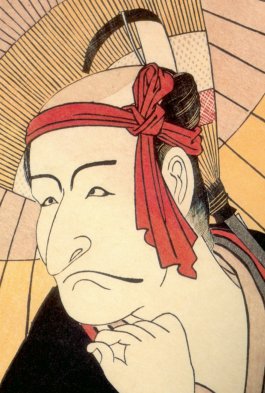
Another example is the term "hachimachi" in the following picture (source: 空の軌跡, made by my favorite game company Falcom). "Hachimaki" means headband, or 鉢巻. There are a few important things about 鉢巻: 1) 鉢巻--the kanji version--is a commonly used term (according to Denshi Jisho); 2) Even though Japanese people are not wearing Hachimaki very much nowadays, but, at least according to Google image searches, hachimaki is still mostly commonly associated with this Japanese style headband that usually has encouraging words in red (please refer to リジュンさん's photo in my last blog post). The question then becomes why did 空の軌跡's game maker decide to write 鉢巻 in katakana? 鉢巻 clearly does not fall into any of the common categories (loanwords, onomatopoeia, and emphasis).
I would like to argue that this decision to use ハチマキ instead of 鉢巻 or はちまき is, in fact, for emphasis. But this use of emphasis is not in the same way as how おやじ is written as オヤジ. First of all, 空の軌跡 has an imaginary but heavily Western industrial--sort of--setting. Due to the nature of the game, it would be awkward to have something that is "very Japanese" appear as an accessory on a game character. So perhaps the game maker want to use katakana to emphasize that this headband, hachimaki, is not what a native Japanese speaker would normally expect (a headband with encouraging words in red). Instead, it is just a headband and no more. In a way, katakana is used to
deemphasize the nativeness of the word.
At the conclusion of my first example, I brought up a few questions that might or might not have a clear answer. Why do most of the textbook examples given to us evade emphasis, whose use is as unclear and puzzling as I demonstrated in the previous two examples? I think there could be a few possible explanations. First of all, a textbook can't explain everything, especially an intro-level textbook. As a native Chinese speaker, I could not possibly imagine a book that can fully explain the uncountable subtleties of the Chinese language. The use of emphasis through katakana is sometimes painfully straightforward (like its use in loanwords and onomatopoeia), but it can be also very, very subtle. To fully understand those subtleties--to a point that we could use them with ease--requires us to have day-to-day interaction with Japanese people and culture for a very long time. Textbook explanations would never suffice. Therefore, these textbooks did what they could with explaining the overarching idea, which is that katakana is used mainly for loanwords and onomatopoeia.